
- By Brian Donohue
- Roofing Insurance Guides
- 0 Comment
If your roof gets damaged and you file a claim, there’s a single line in your policy that determines whether you get a check that covers most of a new roof — or a check that covers a fraction of it. Most homeowners never read that line until they need it, and by then it’s too late to change anything about the payout.
That line is whether your policy pays on an Actual Cash Value (ACV) basis or a Replacement Cost Value (RCV) basis. They sound like minor fine print. They are not. On an older roof, the difference between the two can be the difference between a $4,000 check and a $14,000 check for the exact same damage.
The Short Version
- RCV (Replacement Cost Value) pays what it actually costs to replace your roof today, with no deduction for age or wear.
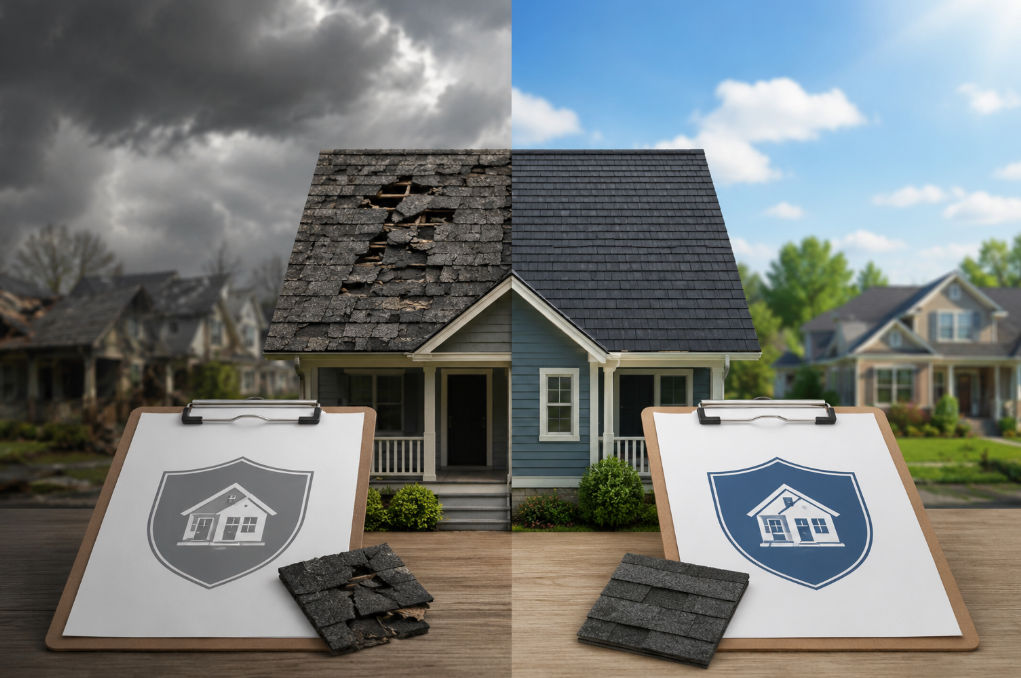
- ACV (Actual Cash Value) pays the replacement cost minus depreciation — meaning the older your roof, the less you get, even though the cost to actually replace it hasn’t gone down at all.
Same storm. Same damage. Same roof. Two very different checks, depending on which one is written into your policy.
How Depreciation Actually Works on an ACV Policy
Insurance companies calculate depreciation based on your roof’s age relative to its expected lifespan. A standard 3-tab or architectural asphalt shingle roof is typically assumed to have a 20-25 year lifespan for depreciation purposes, regardless of how well it’s actually held up.
So if your roof is 12 years old and your insurer treats shingles as a 20-year asset, you’ve already “used up” 60% of its expected life in their depreciation math. That percentage gets subtracted from your payout.
Example:
- Cost to replace your roof today: $14,000
- Roof age: 12 years (treated as 60% depreciated)
- Depreciation deducted: $8,400
- ACV payout: roughly $5,600 — before your deductible is even subtracted
On an RCV policy, that same roof gets the full $14,000 (minus deductible), regardless of age.
Why This Matters More in Missouri Than Most States
St. Charles and St. Louis County see frequent hail and severe wind events, which means roofs here get claimed more often — and insurers have responded by pushing more policies toward ACV for roofing specifically, even when the rest of the home’s coverage is RCV. It’s increasingly common to have a policy that’s RCV for your siding, windows, and interior, but ACV specifically for the roof, especially once the roof passes a certain age (often 10-15 years, depending on the carrier).
This is also frequently bundled with a separate, higher wind/hail deductible (often 1-2% of your home’s insured value) layered on top of the ACV reduction — which means an older roof in this region can end up significantly underinsured for storm damage without the homeowner ever realizing it.
How to Find Out Which One You Have
Don’t guess, and don’t rely on what your agent told you when you first signed up — policies get updated at renewal, sometimes without much fanfare. To check:
- Pull your current Declarations Page (the 1-2 page summary at the front of your policy, not the full policy document).
- Look for “Roof Surfacing” or “Roof Coverage” as a separate line — many Missouri carriers now list roof coverage independently from the rest of the dwelling coverage.
- Look for the terms “ACV,” “Actual Cash Value,” “Functional Replacement Cost,” or “Cosmetic Damage Exclusion” — any of these next to your roof coverage is a signal you’re not getting full replacement value.
- Call your agent and ask directly: “Is my roof covered at replacement cost or actual cash value, and is there a separate wind/hail deductible?” Make them answer both parts.
If you can’t find your Declarations Page, your insurer’s online portal almost always has a copy, or your agent can send one in minutes.
Can You Recover the Depreciation Later? Sometimes.
Some ACV policies include a Recoverable Depreciation clause, which means you can get the withheld depreciation amount back — but only after you actually complete the repair or replacement and submit proof (invoices, photos, contractor documentation) within a set window, often 180 days from the claim. If your policy has Non-Recoverable Depreciation instead, that withheld amount is gone permanently, regardless of whether you replace the roof.
This is worth confirming before you decide whether to move forward with repairs out of pocket while waiting on a claim decision — the recoverable depreciation deadline can run out faster than people expect.
What This Means If You're Filing a Claim Right Now
If you’ve recently had storm damage and you’re not sure which type of coverage applies:
- Get the Declarations Page in hand before your adjuster visit, not after.
- Ask your adjuster directly which basis they’re using to calculate your estimate.
- If recoverable depreciation applies, keep every invoice and document the completed work — that paperwork is what releases the second check.
- If your roof is older and on an ACV policy, get a written, itemized estimate from your roofer so you can compare it against what the insurer’s depreciation math actually withheld.
Depreciation Isn't One Number — Insurers Break It Down by Component
Most homeowners picture depreciation as a single percentage knocked off the total estimate. In practice, adjusters using estimating software (most carriers in Missouri use Xactimate) depreciate each line item separately, based on that component’s individual expected lifespan — not the roof as a whole. That distinction matters because it determines exactly where your payout is getting reduced, and it’s the first thing to check if a settlement looks low.
A typical itemized breakdown looks something like this on a 12-year-old roof:
| Line Item | Expected Lifespan | Age | Depreciation Applied |
|---|---|---|---|
| Asphalt shingles | 20 years | 12 yrs | ~60% |
| Underlayment | 20 years | 12 yrs | ~60% |
| Flashing (metal) | 30+ years | 12 yrs | ~40% |
| Decking/sheathing | 30+ years | 12 yrs | ~40% |
| Labor | N/A | — | Often 0% — labor is frequently non-depreciable |
Two things to actually check against your own estimate:
- Labor is often listed as non-depreciable even on a full ACV settlement, since you can’t “use up” labor the way you use up a physical material. If your insurer depreciated labor costs, that’s worth questioning directly — it’s a common point adjusters get challenged on.
- Metal flashing and decking depreciate slower than shingles because they’re rated for a longer lifespan. If your settlement applied the same depreciation percentage across every line item instead of varying it by component, the math likely wasn’t done correctly.
Ask your adjuster for the full itemized estimate (not just the summary total) — in Missouri, you’re entitled to this, and it’s the only way to actually verify the math rather than taking the bottom-line number at face value.
If You Think the Depreciation Was Calculated Wrong
This happens more often than most homeowners assume, and there’s a real process for challenging it — it isn’t just a matter of calling and complaining.
- Request the full Xactimate estimate, not the one-page summary. This shows every line item and its individual depreciation rate.
- Compare it against an independent contractor estimate. If your roofer’s itemized bid lists different material costs or a different scope of work than the adjuster’s estimate, that gap is the basis for a supplement request.
- File a written supplement, not a phone call. Supplements need to be documented — list the specific line items in dispute and why, supported by your contractor’s estimate and photos.
- Invoke appraisal if your policy includes it. Most Missouri homeowner policies have an appraisal clause: each side picks an appraiser, the two appraisers pick a neutral umpire, and a binding decision gets reached without going to court. This is typically faster and cheaper than litigation and is underused by homeowners who don’t realize it’s already in their policy.
- Escalate to the Missouri Department of Insurance if you believe the carrier is acting in bad faith — delaying without basis, lowballing without justification, or refusing to provide the itemized estimate. The Missouri DOI accepts consumer complaints against carriers operating in the state and will request a formal response from the insurer.
Frequently Asked Questions
Often yes, at your next renewal — but it usually comes with a premium increase, and some carriers won’t offer RCV roof coverage on roofs past a certain age regardless of what you’re willing to pay. Ask your agent specifically about RCV endorsements for roof surfacing.
Not automatically. Even a new roof can be written under an ACV policy if that’s how your overall homeowners policy is structured. Age affects how much depreciation applies, but it doesn’t change which basis your policy uses.
Often yes, especially if your roof is mid-life rather than near the end of its expected lifespan — the payout will be partial, but it can still meaningfully offset replacement cost. It’s worth getting an itemized estimate before deciding either way, since the math varies a lot by roof age and damage extent.
No — Functional Replacement Cost typically pays to replace your roof with materials that are functionally similar but not necessarily identical or full retail cost, and it’s a separate, less generous category than full RCV. If you see this term, ask your agent specifically what it limits.
The insurer’s adjuster calculates and applies depreciation based on your policy terms. Your contractor’s role is to provide an accurate, itemized replacement estimate that the depreciation gets calculated against — which is why an inaccurate or vague estimate can work against you either way.
Know Before the Adjuster Does
The biggest mistake homeowners make with ACV vs. RCV isn’t picking the wrong policy — it’s not knowing which one they have until a claim is already underway. Pulling your Declarations Page today, before any storm, costs you nothing and tells you exactly what you’re working with if damage happens.
If you’ve got storm damage and aren’t sure how your policy will pay out, Horizon Roofing & Exteriors can walk through your roof’s condition and give you an itemized estimate you can hold up against whatever the adjuster comes back with — whether you’re on ACV, RCV, or somewhere in between.

Brian Donohue
Brian Donohue is the owner of Horizon Roofing & Exteriors, the leading roofing company in St. Peters, Missouri, dedicated to delivering quality roofing solutions. With a strong background in project management, sales, and customer service, Brian has built a reputation for reliability and excellence in the roofing and construction industry.