
- By Brian Donohue
- Roofing Insurance Guides, Storm Damage Roofing
- 0 Comment
Most homeowners only meet their insurance adjuster once — usually on one of the worst weeks of the year, right after a storm has torn through St. Charles or St. Louis County. You get a phone call, a date is set, and twenty minutes after the adjuster climbs down off your roof, your claim outcome is largely decided.
That’s not a lot of time to make your case. Which is exactly why it helps to know, before they ever pull up in the driveway, what they’re actually checking for — and what separates a claim that gets fully approved from one that comes back denied or underpaid.
Adjusters Aren't Looking for "Damage." They're Looking for Specific Evidence
Here’s the part that surprises a lot of homeowners: an adjuster isn’t walking your roof asking “does this look bad?” They’re working through a checklist tied directly to your policy’s definitions of covered perils. If the damage doesn’t match what their checklist is built to confirm, it doesn’t matter how rough your roof looks from the street — it may not get written up as a covered loss.
That means two roofs with identical-looking wear can get two completely different claim outcomes, depending on whether the damage can be tied to a specific storm event and matches the pattern that peril produces.
What They Document on the Roof Itself
Several local conditions make algae growth more common throughout the St. Louis area.
Impact Marks and Pattern
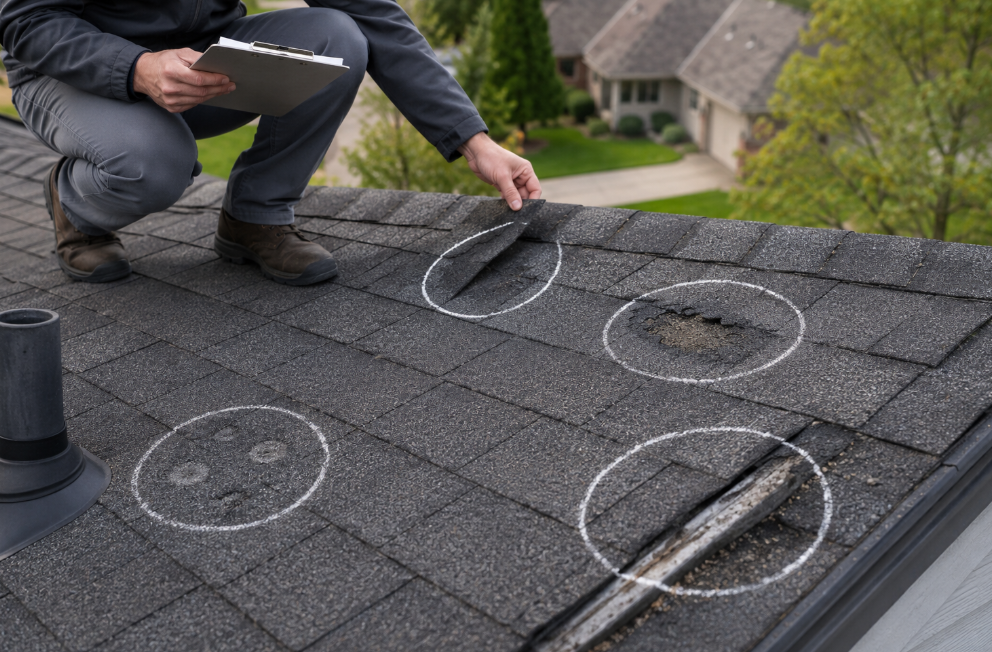
For hail claims specifically, adjusters are trained to count and measure impact marks — not just spot them. They’re looking for:
- Circular bruising on the shingle mat, usually with granules dislodged at the center
- A consistent pattern across multiple slopes (hail falls straight down, so it should mark every exposed surface roughly evenly)
- Soft spots when pressed, indicating the fiberglass or felt mat underneath has fractured
A handful of marks on one slope and nothing anywhere else is a flag for them — it raises the question of whether the damage is storm-related or pre-existing wear.
Granule Loss
Adjusters distinguish between two very different things that look similar from a distance: granule loss from age (gradual, even, often worse near the edges and in valleys where water runs) versus granule loss from impact (concentrated, sharp-edged, paired with mat bruising). Only the second one typically gets written up as storm damage.Shingle Displacement and Seal Failure
For wind claims, they’re checking whether tabs are creased, lifted, or torn, and whether the self-sealing strip beneath the shingle is still bonded. A shingle that’s merely lifted but still sealed is treated differently on paper than one where the seal is broken — even though both can eventually leak.Flashing, Vents, and Penetrations
Chimneys, pipe boots, skylights, and roof-to-wall transitions get specific attention because these are the most common points where storm damage actually turns into an interior leak. An adjuster who only inspects the open field of the roof and skips these areas is doing an incomplete inspection — and it’s fair to ask them to check it if they haven’t.What They Document Off the Roof
This is the part many homeowners don’t expect, and it matters more than people realize: adjusters look for corroborating evidence elsewhere on the property to confirm the storm event actually produced damage consistent with what’s on the roof.
- Gutters and downspouts — dents and dings from hail impact
- Window screens and trim — perforations or paint chipping
- AC condenser fins — bent fins are a commonly cited corroborating sign for hail size
- Any other exterior metal — mailboxes, exterior light fixtures, fence caps
If the roof shows damage but nothing else on the property does, that mismatch can work against the claim. If you can photograph this evidence yourself before the adjuster arrives, you’re ahead of the process rather than reacting to it.
How They Use Local Weather Data
Adjusters routinely cross-reference NOAA storm reports and hail-swath data for the date you’re claiming. If your claimed storm date doesn’t line up with a verified weather event in St. Charles or St. Louis County, that’s a problem for the claim regardless of what the roof looks like. This is one of the simplest things homeowners can check themselves ahead of time — confirming the date and looking up whether the National Weather Service logged hail or wind at that location.
Where Claims Usually Run Into Trouble
In our experience inspecting roofs ahead of adjuster visits across St. Charles, St. Peters, and surrounding communities, the same few issues come up again and again:
- Damage gets attributed to age instead of the storm, especially on roofs already past 15-18 years old, where wear and storm damage can look similar to an untrained eye.
- Only the most visible slope gets inspected, missing damage on the back of the house or low-slope sections.
- No photos exist from before the storm, making it harder to show the damage is new.
- The homeowner didn’t have anyone present during the inspection to point out specific areas or ask the adjuster to re-check a section.
What to Do Before the Adjuster Arrives
- Get your own inspection first. Having a contractor document the roof before the adjuster’s visit gives you a second, independent record to compare against the adjuster’s report.
- Photograph the corroborating evidence — gutters, screens, AC unit, trim — not just the roof.
- Confirm the storm date against NWS records so there’s no question about whether a qualifying event occurred.
- Be present for the inspection, or have your contractor present, so nothing gets missed or written off as pre-existing wear.
- Don’t make permanent repairs beforehand. Tarping to stop active leaking is fine; replacing shingles before the adjuster sees them can void your documentation.
Why a Second Set of Eyes Matters
An adjuster typically spends 20-30 minutes on a roof that may take a contractor an hour to properly inspect, and the adjuster’s job is to evaluate the claim against the policy — not to find every issue on your behalf. That’s not a knock on adjusters; it’s simply a different role than a roofer’s. Having a roofing contractor walk the property either before the adjuster’s visit or alongside them gives you someone whose only job in that moment is making sure nothing gets missed.
If you’ve had a recent storm move through St. Charles or St. Louis County and you’re not sure whether your roof would hold up to this kind of inspection, Horizon Roofing can walk the roof with you, document what’s there, and go over what to expect before you file — or before the adjuster’s visit if a claim is already open.
Frequently Asked Questions
Yes. You can request a re-inspection, submit your own contractor’s documentation as a supplement, or escalate to an appraisal if your policy includes that clause. Disagreeing doesn’t end the claim — it starts a documented back-and-forth, and that’s exactly why having your own inspection report matters.
It can. Adjusters will still complete the inspection, but if no one is present to point out specific damage or ask about an area they skipped, it’s easy for minor-looking damage to get logged as cosmetic rather than functional. Being present, or sending a contractor in your place, gives you a chance to flag anything missed in real time.
Not automatically, but roof age is one of the first things adjusters note, and it raises the bar for how clearly the damage needs to match a specific storm event rather than general wear. This is where dated photos, NWS storm records for your address, and corroborating evidence (gutters, screens, AC fins) carry more weight than on a newer roof.
This varies by carrier, but most adjusters issue a written estimate or denial within a few days to two weeks of the inspection. If you haven’t heard back in that window, it’s reasonable to follow up directly rather than wait indefinitely.
Yes — an independent inspection costs you nothing in most cases and gives you a record either way. If the damage turns out to be minor, you’ve confirmed that. If it’s significant, you have documentation in hand before any adjuster visit, rather than trying to reconstruct it afterward.

Brian Donohue
Brian Donohue is the owner of Horizon Roofing & Exteriors, the leading roofing company in St. Peters, Missouri, dedicated to delivering quality roofing solutions. With a strong background in project management, sales, and customer service, Brian has built a reputation for reliability and excellence in the roofing and construction industry.